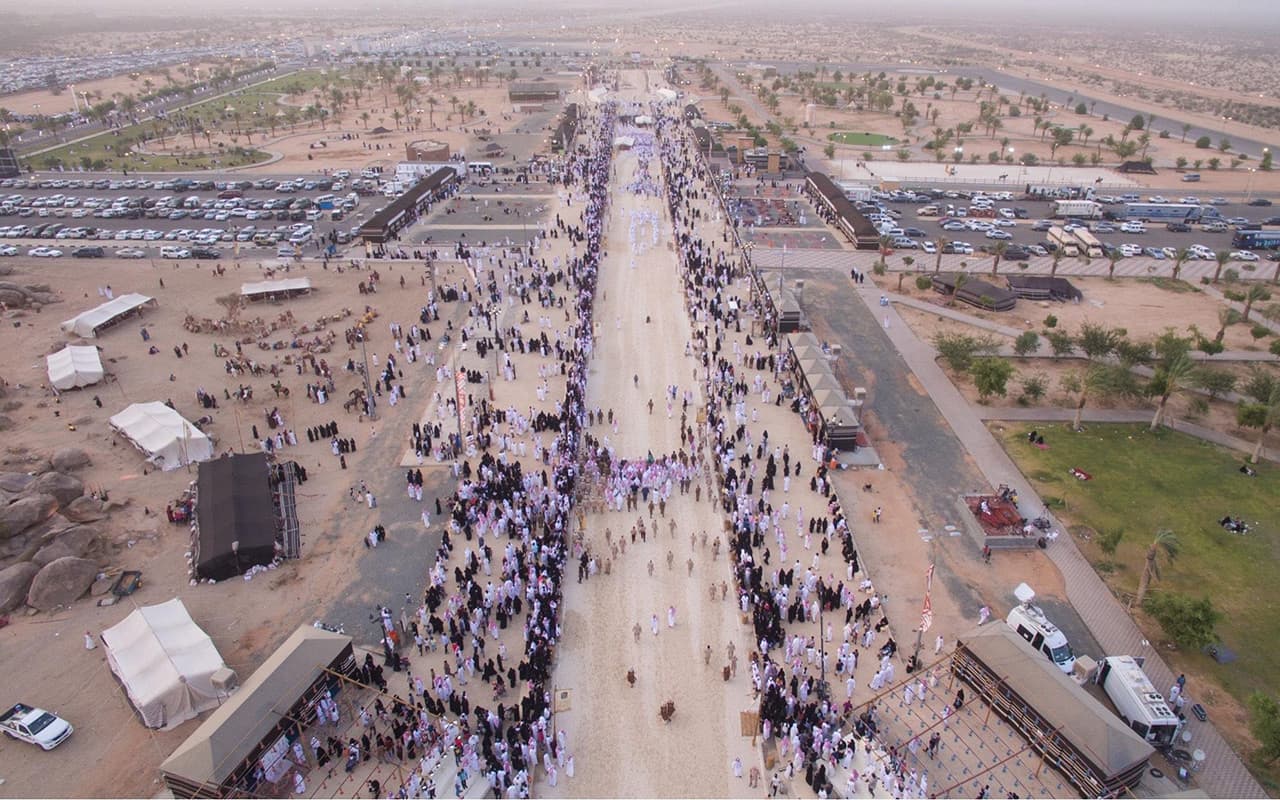
Ukaz Market
Ukaz Market
An Arabian season in the uplands of Taif country, 1–20 Dhu al-Qa'dah: trade, arbitration, and poetic contest. It survived as a station, was wrecked in 129 AH, and the modern season was revived in 1428.
Plan your visit
Practical information verified separately from the historical record.
Access: شرق الطائف؛ الوصول بالسيارة لكن تشغيل الفعاليات والخدمات موسمي.
Before you go: Check with the operator or a local guide before departure; field access details have not yet been verified.
Why visit?
The Jahili season that tied verse to trade and law, then a Hajj station, then ruins, then a state festival.
Ukaz is one of the three great Arabian markets, with Majanna and Dhu al-Majaz. Modern work puts it some forty kilometres north of Taif; the ancients put it in the high Najd of Qays, a night from Qarn al-Manazil. The disagreement is part of the site’s history.
The season ran from 1 to 20 Dhu al-Qa'dah, then people moved to Majanna, Dhu al-Majaz and the Hajj. Taif leather — adim Ukaz — Yemeni cloaks, Syrian arms and Persian scent were sold; alliances and blood-money were declared before a witnessing crowd. The name is from mu'akaza, poetic contest. 501 CE is a modern conventional start-date, not an inscribed year.
In 129 AH / 747 the Haruriyya under al-Mukhtar ibn Awf wrecked it when they held Makkah. It lingered as a Yemen–Hijaz station into the sixth century AH, then the season died. It was revived as a cultural season in 1428 / 2007; the modern ‘city’ was declared in 1439 / 2017. Rock drawings and Kufic graffiti in the district are landscape evidence, not a poet’s stall.
Ibn Bulayhid’s map in Sahih al-Akhbar is the visual document used here, not a festival photograph.