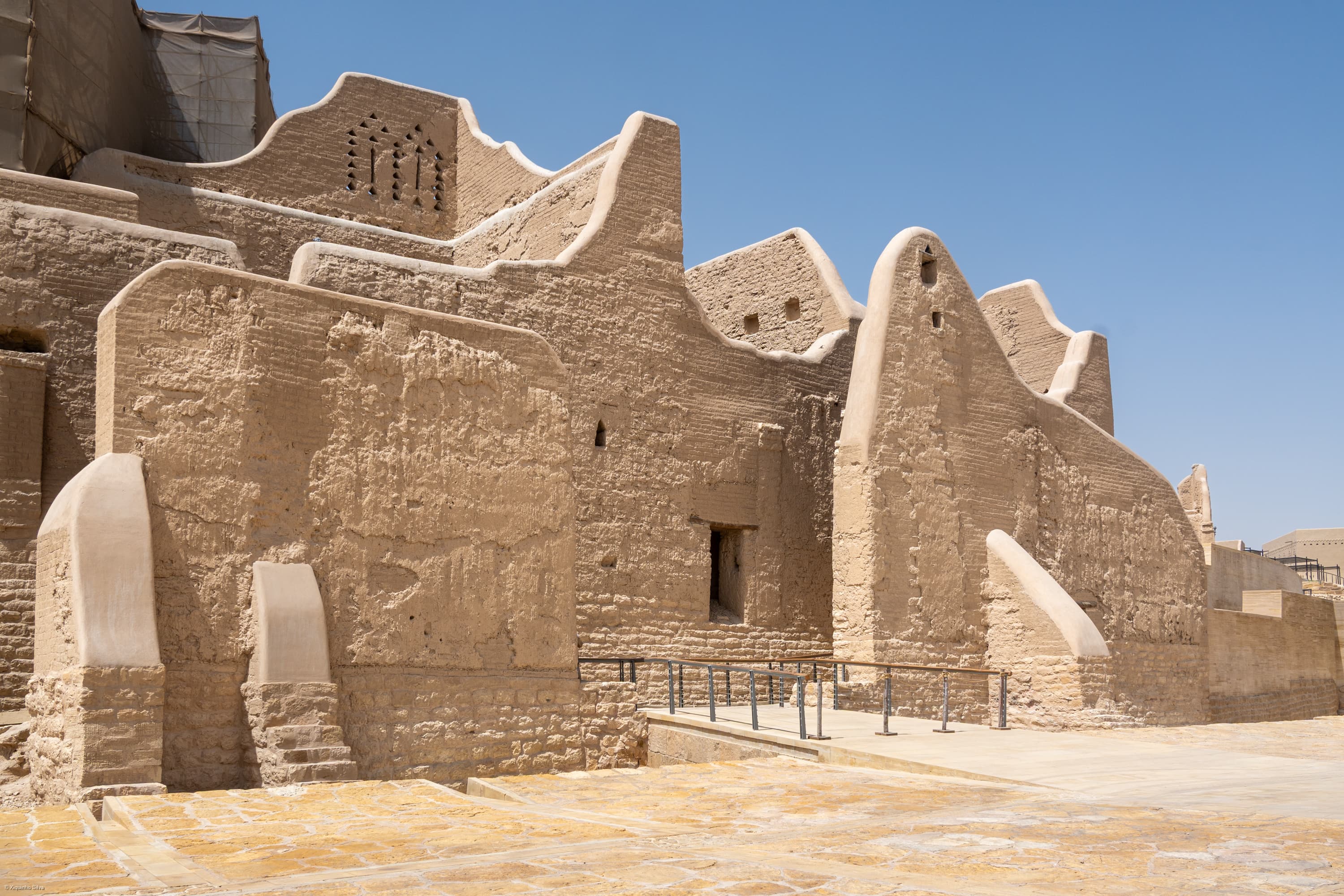
At-Turaif District
At-Turaif District
At-Turaif in Diriyah was the capital of the First Saudi State on Wadi Hanifah—one of the world’s largest mud-brick districts and a UNESCO World Heritage Site since 2010.
Plan your visit
Practical information verified separately from the historical record.
Access: مواقف وزيارات منظمة في نطاق الدرعية؛ اتبع تعليمات الدخول والمسارات داخل الطريف.
Before you go: Check with the operator or a local guide before departure; field access details have not yet been verified.
Why visit?
At-Turaif is where the First Saudi State can be read in stone and mud: power, administration, Najdi architecture, and community life along Wadi Hanifah—a gateway to the roots of modern Saudi identity.
On the western bank of Wadi Hanifah, northwest of Riyadh, At-Turaif stands as living evidence of a moment that reshaped the Arabian Peninsula. Palaces here were not built for ornament alone—they became the seat of a state and a political project that lasted nearly a century.

From oasis town to Saudi capital
Settlement at Diriyah reaches back to roughly the fifteenth century. The historic leap came with the First Saudi State (1727–1818). Imam Abdulaziz bin Muhammad bin Saud made At-Turaif the seat of government and the ruling family’s residence around 1766, turning the district into the political and architectural heart of the state.
Salwa Palace and Najdi fabric
The district is a dense Najdi mud-brick fabric: walls, lanes, multi-storey palaces, mosques, and administrative buildings. Salwa Palace, Bayt al-Mal, and Sibalat Mawdi are among the landmarks that show how power and everyday life shared one capital. Adobe, plaster, and local wood form a complete architectural language of central Arabia.
UNESCO and memory
After the 1818 siege ended the First Saudi State, At-Turaif remained a reference for architecture and identity. In 2010 it was inscribed on the UNESCO World Heritage List as one of the world’s largest mud-brick districts and an outstanding example of Najdi architecture. Visitors today walk restored walls and open-air museums—and read, in brick and stone, how a capital was born in Najd.