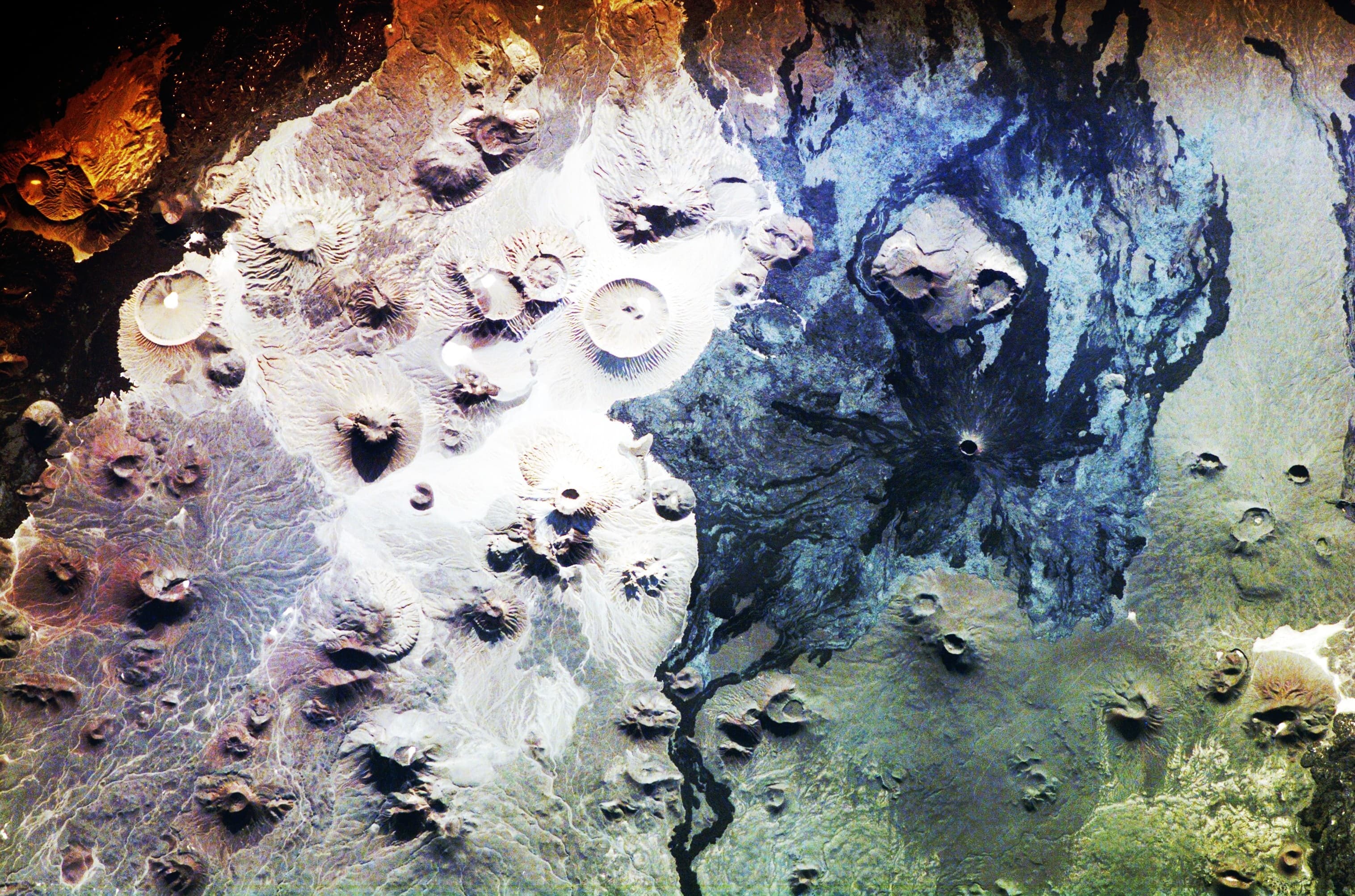
Harrat Khaybar
Harrat Khaybar
One of the largest volcanic fields in Saudi Arabia, covering more than fourteen thousand square kilometers northeast of Medina, home to the kingdom's highest volcano Jabal al-Abyad at 2,093 meters and more than nine hundred mysterious prehistoric stone gates.
Plan your visit
Practical information verified separately from the historical record.
Before you go: Check with the operator or a local guide before departure; field access details have not yet been verified.
Why visit?
Explore a globally recognized geological heritage landscape where recent Islamic-era eruptions, lava tubes, and Neolithic structures share one volcanic expanse.
Harrat Khaybar is among the most diverse and scientifically rich volcanic fields in Arabia, extending over more than fourteen thousand square kilometers in the Hijaz. Its highest point, Jabal al-Abyad at 2,093 meters, stands beside Jabal al-Bayda, built of white rhyolite in striking contrast to the surrounding black basalt. The field's last volcanic eruption occurred between roughly 600 and 700 CE, at the dawn of the Islamic era.
Among its geological wonders is the Umm Jirsan lava tube, 1,481 meters long and the longest known in the kingdom. Archaeologically, researchers have recorded more than nine hundred stone "gates" and related structures from the Late Neolithic period, features unique on a global scale. In 2022 the International Union of Geological Sciences classified Jabal Qidr within the harrat as a world geological heritage site.
Harrat Khaybar unites active earth processes with a deep human past, making it essential for understanding both the volcanic architecture of the Hijaz and the ritual or pastoral landscapes of prehistoric Arabia.